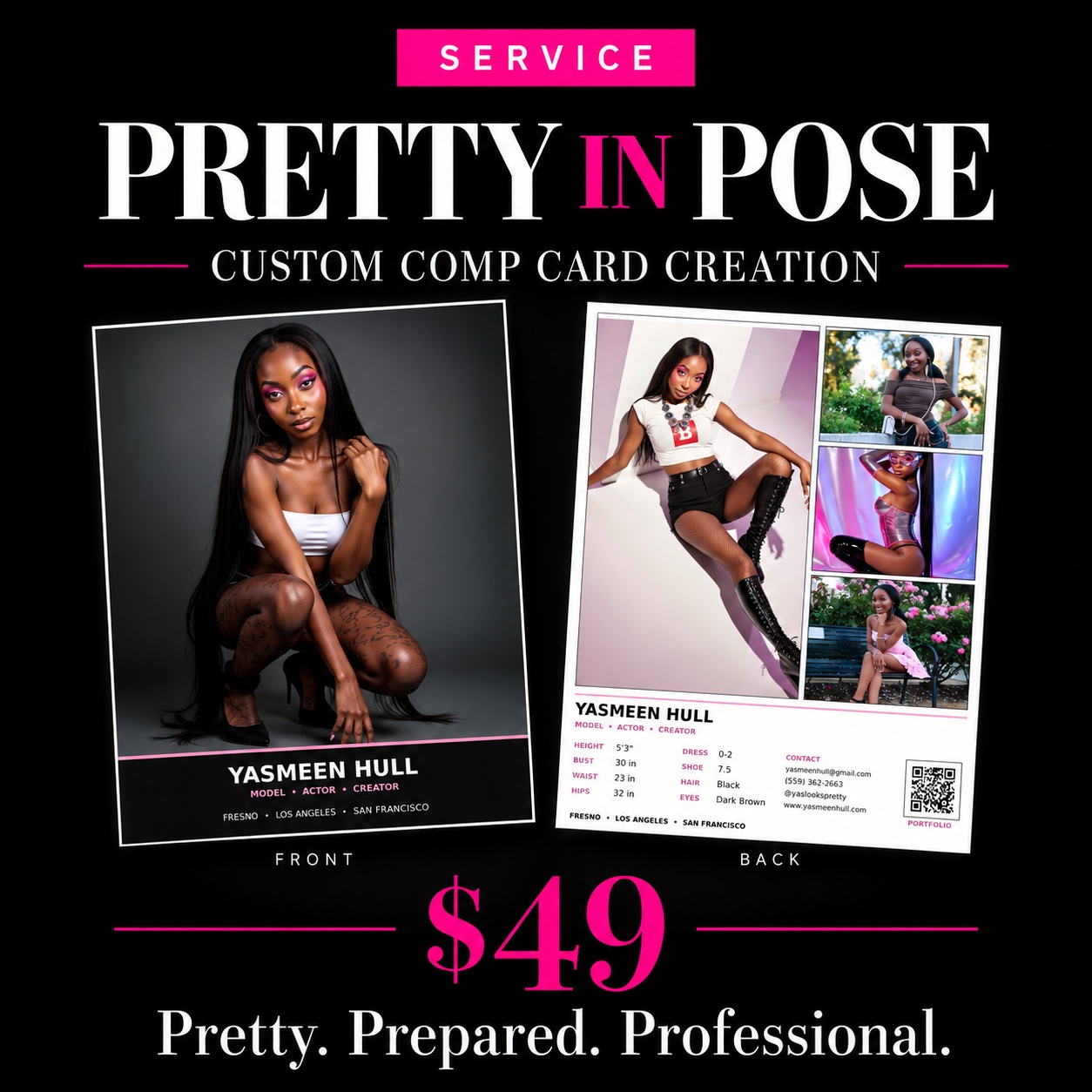
A model comp card is a compact introduction to you as a model. It brings together a small group of strong photos and the practical details a client, photographer, or casting professional may need to remember you and consider you for work.
The hard part is not filling the space. It is deciding what deserves to be there. A clean card with a clear point of view will usually serve you better than a crowded card trying to prove everything at once.
Start with one unmistakable front image.
The front of your comp card should make it easy to recognize you. Choose one current, high-quality photo with a clear view of your face. The image can still have personality, but your styling, makeup, pose, or editing should not make you difficult to identify.
Your name should be easy to find without competing with the photo. You do not need a long biography, a paragraph about your goals, or a list of every modeling category you hope to explore. Let the front make one confident introduction.
Use the back to show useful range.
The supporting images should add information instead of repeating the same pose, outfit, crop, and expression. A thoughtful selection might include a clear headshot, a full-length image, a commercial or lifestyle expression, and a fashion, beauty, or movement image that supports the work you want.
You do not need every possible category on one card. Choose images that make sense together and support your current modeling lane. If you are pursuing commercial work, a warm lifestyle image may be more useful than four dramatic editorials. If beauty is your focus, close-up detail matters more.
Include the details people actually need.
Your information should be current, accurate, and easy to scan. Depending on your lane and the opportunity, useful details may include:
- Your professional name
- Height
- Current measurements that are relevant to your work
- Dress, suit, shoe, or other sizing when appropriate
- Hair and eye color
- Your agency contact information, if you are represented
- A professional booking email or portfolio website, if you are independent
- Your location or market when it helps clarify where you work
Exact expectations can vary by market, agency, client, and type of modeling. If a submission provides specific instructions, follow those instructions instead of treating one template as universal.
Protect your private information.
A comp card is meant to be shared. That means it should not contain your home address, personal schedule, private phone number, or any information you would not want passed from one person to another.
Use a dedicated professional email. If you include a website or social account, make sure it supports your modeling presentation. Your materials should make contacting you simple without making your private life public.
Leave off anything outdated or unverified.
Do not keep an old photo just because it was expensive to create. If your hair, body, measurements, or overall appearance has changed enough that the image could create confusion, update the card.
Also leave off experience you cannot explain, agency logos you are not authorized to use, and credits that make ordinary collaboration sound like a major booking. A professional card does not need exaggeration. It needs accuracy.
Avoid turning the design into the main character.
Your comp card can feel polished and personal without burying your photos under decorative fonts, heavy graphics, long quotes, or too many colors. The design should help the viewer understand your images and information—not compete for attention.
Give every element room to breathe. Keep type readable. Use consistent spacing. Before you approve the card, check both the full-size file and a small phone preview. A detail that looks beautiful on a large screen can become unreadable when the card is shared digitally.
Prepare files for both digital and print use.
Keep a high-resolution version for printing and a clear digital version that is easy to email or upload. Use a professional filename that includes your name instead of something like “final-final-2.” Test every website, email, social, or QR link before you share the card.
If you print copies, review one physical sample before ordering many. Look for small text, unexpected cropping, dull colors, and any photo that prints darker than it looked on screen.
Know when it is time to update your card.
Review your comp card whenever your appearance, measurements, contact information, representation, market, or strongest portfolio images change. You do not need to redesign it every week, but it should represent the model who will actually arrive.
If you are still choosing your photos, use the Pretty in Pose portfolio tools to identify your strongest images and any missing shots. If you want the finished layout created for you, explore the Custom Comp Card Creation service.
Your card should make the next step easy.
A strong comp card answers three questions quickly: What do you look like? What kind of work can someone imagine you doing? How can they reach the correct person?
Keep it current. Keep it readable. Keep the focus on you. The goal is not to fit your entire career onto one card—it is to give the right person a clear reason to look closer.